Inside Syria’s Secret Coronavirus Crisis
This post is also available in:  العربية
The Assad regime is suffering a massive outbreak-and burning the bodies in silence.
The current running gag among Damascenes making light of their dire circumstances is that the official number of coronavirus infections in Syria is as accurate as that of the Syrian pound’s official exchange rate with the U.S. dollar—that is to say, not at all. Syria—forced to deal with war, sanctions, and economic crisis—has long been rumored to be suffering from a major coronavirus outbreak that the regime won’t admit. Foreign Policy has now confirmed that the outbreak is real—and the regime’s motivations in denying it are even more cynical than they appear on the surface.
At 4 p.m. on July 20, a heaving, feverish, and very ill Anas al-Abdullah (whose name, like most of those mentioned in this article, has been changed) visited al-Mujtahid Hospital in Damascus. Within 12 hours, he had died and was soon after buried in Najha cemetery in the desert on the outskirts of the capital.
Najha is best known as the place where the regime allegedly buried some of the hundreds of thousands victims of its notorious prison system. However, recent satellite imagery and photos circulating online reveal that Najha has now turned into the final resting place of Syrians who have died due to the coronavirus. Doctors told Abdullah’s grieving family he had COVID-19, and his burial at Najha by state officials confirmed it. Yet the death certificate mentioned only pneumonia as the cause, leaving the family perplexed.
Abdullah’s father, a rebellious cleric who supported the uprising against Bashar al-Assad, was often chased by the state’s intelligence services and fled to Qatar fearing persecution. Abdullah, however, accepted the unspoken but brutally enforced rule that you challenge the Assad clan at your peril and stayed in the country. He was not targeted by the regime but was killed by its inefficiency nonetheless. He died as he gasped for air without a respirator in a major hospital that was one of the three in Damascus supposedly equipped to deal with coronavirus patients. His brother spoke to Foreign Policy on the condition of anonymity. “At first, doctors gave him a respirator but later took it away to resuscitate somebody else,” he said. “That is what led to his death. We don’t know if the doctors have been asked to hide the real cause so the government can keep the numbers down, but it is all very confusing. But I can’t say more—you know our situation here.”
According to the Syrian government, just over 2,300 people have tested positive, and fewer than a hundred have died of the virus. But these are not even a fraction of the total cases, said more than a dozen Syrians, including those who suspected that their family members had died of the coronavirus, several others who were too scared to report that they had been infected, and health workers who complained about an absence of contact tracing and a dire shortage of the basic safety equipment needed to save themselves and their patients.
At least six top clerics in Damascus, three media professionals, two judges, and several members of the Syrian Constitutional Committee have tested positive. In further evidence of the uncontrolled spread of the virus, Jordan shut down its northern border crossing, about 70 miles from Damascus, after it recorded a steep rise in infections coming through Syria.
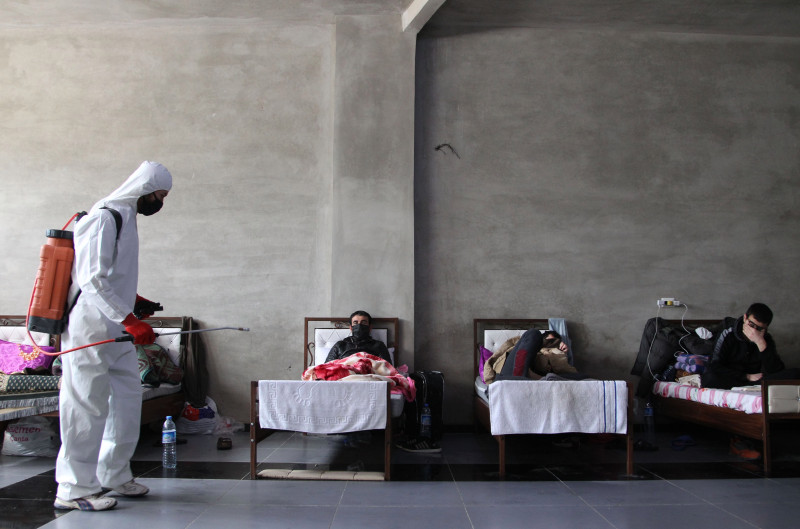
Speaking to Abdullah’s brother led Foreign Policy to scores of others in quarantine in just one neighborhood in Damascus, al-Midan, where Abdullah lived. They claimed to know hundreds more. Abdullah’s nephew and his neighbor are both symptomatic, but they preferred to quarantine at home and avoid state-run hospitals as long as they could. “I am afraid to go to a quarantine center. They are like jails,” the nephew said. “I am afraid of the government.”
“Quarantine centers are like the detention centers where they torture civilians and leave them to die,” the neighbor added. Their comments reflected a deep fear of the state in the minds of many Syrians who have, for so long, been subject to the repression of the state, arrested and thrown into dungeons on the slightest suspicion of conspiring against the regime.
One reason behind the low official coronavirus count in Syria is underreporting by those who have it. Many say they want to avoid being noticed by the authorities owing to their political views or are afraid of being left to die in dilapidated health care centers. But a bigger obstruction in finding the actual tally is the systematic refusal of the state to confront the problem.
An orthopedic surgeon at al-Mujtahid Hospital who also requested anonymity said he lost his father to the virus and is struggling to get tests for 30 other relatives showing obvious symptoms. He said no one from the Health Ministry had tried to reach out to contact-trace and mitigate the spread. “Hospitals need to test 10,000 people a day, but they are only testing 10 percent at best,” the surgeon said. “There are just about 13-15 respirators in al-Mujtahid and 130 or so in all of Damascus.” He forecast that at the current pace 1 in 4 Damascenes could be infected in the coming weeks. “The government knows, but we don’t understand why it is not revealing the real situation on the ground,” he said.
Two sources told Foreign Policy that the area around Damascus is dotted with members of Iran’s Islamic Revolutionary Guard Corps and the fighters of its Lebanese ally Hezbollah. Bassam Barabandi, a former Syrian diplomat, claimed the virus made its way into Syria through Iranian visitors. “The hub has now moved from Iran to Syria,” he said. While the Damascus regime imposed early lockdown measures in March, they were quickly lifted due to economic distress. Keeping the official numbers low seems to be an attempt by the regime to salvage its reputation among loyalists without jeopardizing relations with its Iranian patrons. “Coronavirus cases affect the legitimacy of the regime,” Barabandi added. “The loyalists will say, ‘You cannot provide food, you cannot provide electricity, and now we are dying because of the virus.’ That is why the regime is keeping the numbers low, to give the impression that everything is under control.”
As the military conflict of the last nine years subsided, regime loyalists expected rewards. But Assad has nothing to offer since the expected inflow of reconstruction funds has been halted by, among other causes, sanctions imposed by the United States under the Caesar Syria Civilian Protection Act, which is intended to prevent funds reaching regime officials but is also a major disincentive to investment. Half of the population is out of work, and more than 80 percent of Syrians are living below the poverty line, all of whom have reason to feel cheated. Assad’s allies, Russia and China, sent some aid to combat the coronavirus but not enough to meet all the country’s needs. The United Arab Emirates also promised support to fight the pandemic, with the strategic aim of inching closer to a regime it once derided.
The World Health Organization (WHO) said it had provided to Syria 4.4 million pieces of personal protective equipment, such as masks, gloves, and sanitizer, and that it was making sure at least a 1,000 tests a day were conducted. However, it acknowledged much more was needed to contain the virus. Akjemal Magtymova, the head of mission and WHO representative in Syria, told Foreign Policy that a glaring dearth of health care professionals, many of whom fled the country during the nearly 10-year war, is a major impediment. But sanctions on Syria, and the U.S. slashing of WHO funding, have made it harder to help the Syrian people, she added.
While the Assad regime has not been known for its concern for ordinary Syrians, it now seems to even be turning its back even on its loyalists. Many Syrians fear that herd immunity has been adopted as an unstated but official policy. Haggard and striving to feed their families, Syrians have become fatalistic about the help they need but no longer expect to ever come.
BY Anchal Vohra, the “Foreign Policy”