Al-Joura and Al-Qusour neighborhoods massacre. When blood became the ink of memory
This post is also available in:  العربية
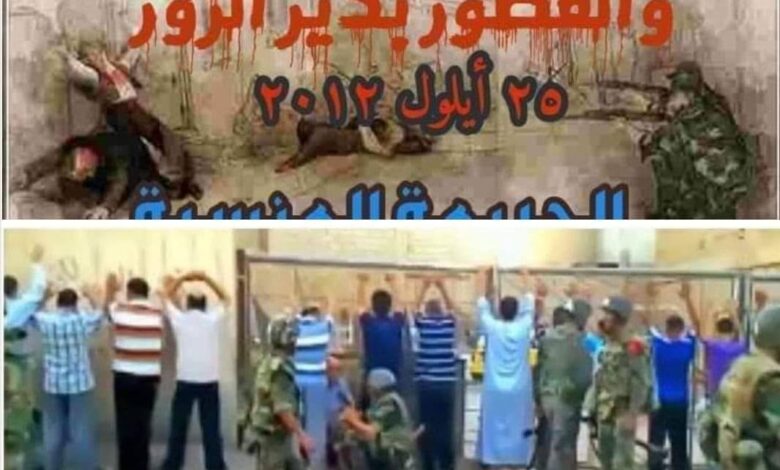
Fourteen years ago, at exactly seven in the morning, the Al-Joura neighborhood in Deir Ezzor woke up to one of the bloodiest pages of horror in the city’s memory. That morning was not ordinary, as the streets of the neighborhood turned, within a few hours, into a scene of shelling, killing and arrests, while civilians lived a day that those who lived it described as similar to “Doomsday.”
The raid began from several axes, including Al-Hersh, Al-Salamah Roundabout towards the suburb intersection and the main street, State Security Roundabout, Water Roundabout, and Globe Roundabout. The attacking forces accompanied helicopters over the city, while various military and security units participated, including brigades from the Republican Guard and the 137th Brigade, along with elements from various security agencies and militia fighters.
The bombing was intense from the first hours. Tanks targeted Al Wadi Street, while snipers were deployed on several axes, especially Al Wadi Street and Prison Street, to impose fire control over the area and target everyone who moved in the streets.
According to testimonies from residents that were circulated and documented at the time, military groups initially entered carrying lists of wanted names, before other groups followed whose names were involved in field killings. Amid the chaos and terror, mass killings occurred in more than one location within the neighborhood.
Near the shops of Al-Dalaf, about 21 young men and men were gathered and killed inside a house, while 11 people were killed near the Quba’a Mosque, including the imam of the mosque, according to accounts that documented the events of that day.
Staying indoors was no guarantee of survival. Many civilians were unable to return to their homes, shops were closed, and people found in the neighborhood were killed. Among the victims were bakery and furnace workers, and testimonies also provide the names of a number of workers who were killed after being burned.
Even the wounded were not immune from being killed. Testimonies say that Suleiman al-Karif, a Free Syrian Army fighter, was hit by a shell and managed to reach a field hospital, before the attacking forces caught up with him and killed him inside.
The field hospital, which was supposed to be a place to treat the injured, has also been turned into a killing site. Documented accounts from the neighborhood’s residents indicate that a number of wounded were killed inside the hospital, in addition to Dr. Haider Al-Fandi and his child brother Hatem.
Among the victims were civilians who had nothing to do with the fighting, including the child Hossam, who was no more than sixteen years old and was known for his participation in the demonstrations, and Uday Al-Sabti, who, according to the circulating story, returned to his home after guaranteed safety and was shot dead.
The testimonies also mention the names of Nasser Al-Radisat, known for selling salt, and Hanoush Daghim, an employee at the Electricity Corporation, who accounts say was robbed before he was killed near his home, in addition to the young man Amer, who was found alone in his home.
As the day extended, the shelling and shooting did not stop. Until 10 p.m., the sound of bullets and shells remained the dominant sound in the neighborhood. At the same time, hundreds of people, including young people and the elderly, were arrested, according to residents’ testimonies, while communications and electricity were cut off, leaving residents finding themselves completely isolated from the world, unable to know the fate of their relatives and loved ones.
Then came the next day, and as the attacking forces withdrew from parts of the neighborhood, the harshest picture began to emerge.
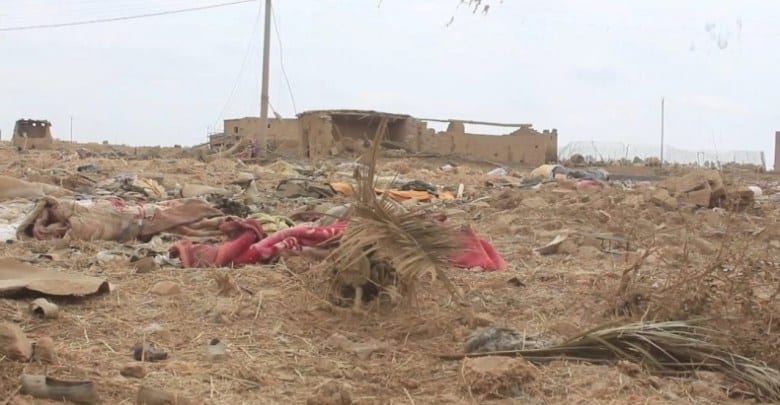
In the neighborhoods, traces of blood and destruction bore witness to what happened. Families are searching for their children, others are receiving news that one of their members has been killed, while other bodies remain unidentified due to the burning and mutilation they were subjected to.
Amid these circumstances, attempts began to document the names of the victims, despite the great risks surrounding the documentation process. According to the record prepared at the time, the death toll rose on the first day to about 250 people, before the toll on the second day, after documenting the victims of injustice and palaces, reached about 460 dead, including a large number of unidentified people.
Burying the victims was not easy under the siege and fear. With the inability to reach the cemeteries, the gardens and courtyards of some mosques were turned into places for burying the dead, so that these sites became part of the neighborhood’s memory and a witness to the scale of the tragedy.
These events were not just numbers on the victim registry. Behind every name there was a home, a mother, a father, brothers, friends, and a story that was suddenly cut short. That is why the memory of injustice remained present in the conscience of the people of Deir Ezzor, despite the passage of years.
Fourteen years later, the names of the victims, the testimonies of survivors, and the locations of the crimes still hold one question: How can a city forget a day when it lost so many of its people?
Documenting what happened is not a recall of the past for revenge, but rather a preservation of memory and the right of victims and their families to have their stories present. Undocumented events may lose their details over time, while names and testimonies give memory a chance to survive.